
Stronger
in 21 days.
After 50.
Twenty-minute home workouts with a chair and a band, a gentle walking plan and simple balance work. Built by a personal trainer for real bodies over 50.
What 21 days can do for you
In the first weeks of strength training, your nervous system learns to use the muscle you already have. That's why many people feel steadier long before their muscles grow.
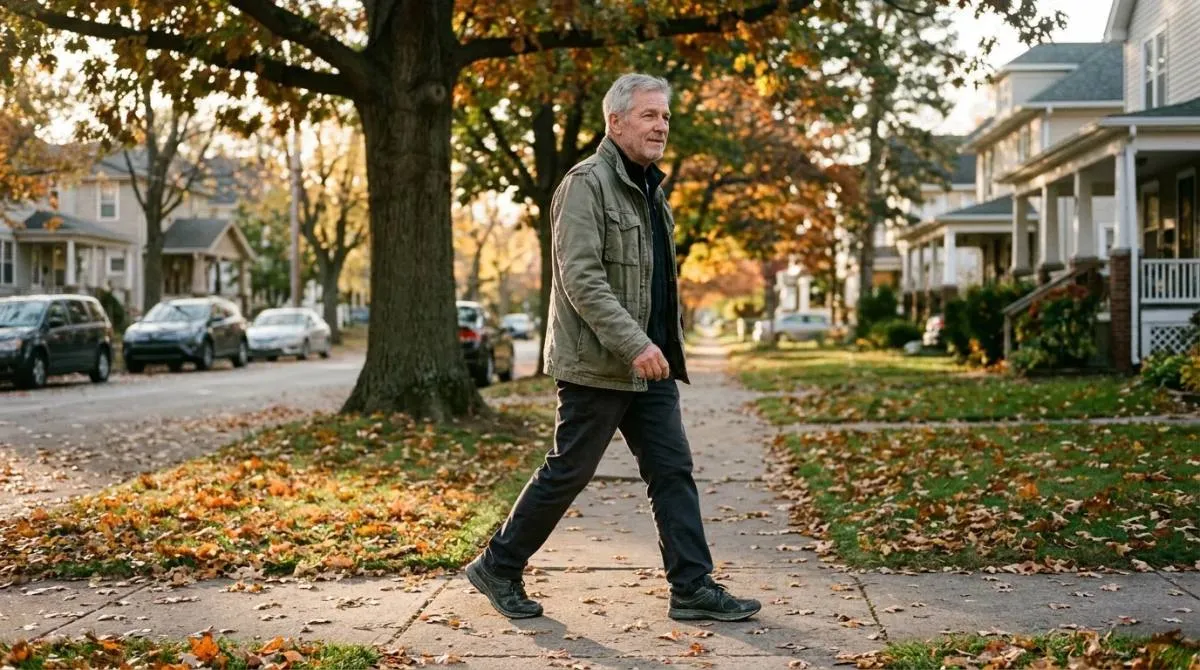
to stand upGetting up from a chair or the couch is one of the first things people notice.
balanceBalance work can improve even in short programs.
legsBands and chair moves build the strength stairs and groceries ask for.
you keepTwenty minutes, three times a week, at home. Simple enough to stick.
Honest timeline: visible muscle growth usually takes 8 to 12 weeks, and blood pressure changes 1 to 3 months. Steady Steps is the start.
Three weeks. One step at a time.
Six basic moves, with the chair as your support. Confidence first.
- 3 sessions, 15–20 min
- Sit-to-stand, wall push-up, band row
- 10-minute walk after one meal
- Day 1: chair stand test
A few more reps and the first balance challenges.
- 3 sessions, about 20 min
- Band press and step-backs
- Heel-to-toe and supported one-leg stand
- Walks grow to 15 minutes
Slower tempo, a firmer band, less help from your hands.
- 3 sessions, 20–25 min
- Optional light kettlebell
- Balance without holding on
- Day 21: repeat the chair test
The 30-second chair test
Arms crossed, count how many times you can fully stand up and sit down in 30 seconds. The CDC uses this test to check leg strength and fall risk. You'll do it on day 1 and day 21.
Below-average scores, by age (CDC STEADI)
| Age | Men: fewer than | Women: fewer than |
|---|---|---|
| 60–64 | 14 | 12 |
| 65–69 | 12 | 11 |
| 70–74 | 12 | 10 |
| 75–79 | 11 | 10 |
| 80–84 | 10 | 9 |
A below-average score is worth discussing with your doctor.
Why strength matters after 50
Elastic band training works too: reviews of dozens of studies found better strength, chair-stand scores and balance in older adults. And the American Diabetes Association recommends strength training 2 to 3 days a week for adults with type 2 diabetes.
Three levels, one steady path
Chair, band and body weight, plus walks after meals and daily balance. For beginners or anyone getting back into it.
Longer, brisker walks and gentle intervals, for heart health and stamina.
Progressive strength with heavier bands, kettlebells or dumbbells, still at home.
4 bonus guides with Steady Steps
Join the 21-day program and get every Steady Days guide at no extra cost. Science-backed, easy to follow and written for life after 50.
 Kitchen · 14 pages7 Easy Breakfasts for Steadier MorningsSeven protein-rich breakfasts, a weekly plan and a shopping list.
 Blood Sugar · 13 pagesSteady Plates: Blood-Sugar-Friendly DinnersSix easy dinners, the plate method, food order and the 10-minute walk, backed by research from PubMed, the CDC and the ADA.
 Heart · 12 pagesKnow Your Numbers: Blood Pressure After 50What your numbers mean, how to measure at home, the DASH way of eating, the wall-sit routine and a 2-week log.
 Mind · 12 pagesSharp at Any Age: Memory & Brain HealthNormal aging vs. warning signs, the 14 risk factors you can change and a 30-day brain health plan.
The breakfast guide is free for everyone. The other three are $7 each on their own, or free with Steady Steps.
Most of us were told to walk more. Nobody told us that muscle quietly slips away every year.
No gym. No jumping. No getting down on the floor.
Just a chair, a band and twenty minutes.
Steady Steps was designed by a personal trainer who works with adults every day, for people who want to keep doing the things they love.
Steady Days.Stronger every week.
Leave your email and we'll let you know when the 21-day program and the follow-along videos are ready. No spam, unsubscribe anytime.
Is it right for me?
Steady Steps is for adults over 50 who can stand up from a chair, with or without help, and walk on their own. If you have a heart condition, diabetes, high blood pressure, joint replacements or recent surgery, or you aren't sure, talk to your doctor first. Stop and seek care if you feel chest pain, dizziness or unusual shortness of breath.
See how movement fits into real life: Linda's story, Ray's story and Diane's story.
Sources and research (11)
- National Institutes of Health (NIH News in Health), "Slowing Sarcopenia: Keep your muscles healthy as you age."
- CDC, "Older Adult Activity: An Overview" and "What Counts as Physical Activity for Older Adults," based on the Physical Activity Guidelines for Americans, 2nd edition (HHS).
- HHS Office of Disease Prevention and Health Promotion, Physical Activity Guidelines Midcourse Report: Implementation Strategies for Older Adults (2023).
- Sherrington C. et al., "Exercise for preventing falls in older people living in the community," Cochrane Database of Systematic Reviews, 2019. PubMed 30703272.
- Martins W.R. et al., "Elastic resistance training to increase muscle strength in elderly: a systematic review with meta-analysis," Archives of Gerontology and Geriatrics, 2013. PubMed 23562413.
- Meng Y. et al., "Effects of elastic band resistance training on lower limb strength and balance function in older adults: a systematic review and meta-analysis," Frontiers in Sports and Active Living, 2025.
- Momma H. et al., "Muscle-strengthening activities are associated with lower risk and mortality in major non-communicable diseases," British Journal of Sports Medicine, 2022. PubMed 35228201.
- Häkkinen K. et al., "Neuromuscular adaptation during prolonged strength training, detraining and re-strength-training in middle-aged and elderly people," European Journal of Applied Physiology, 2000. PubMed 11072774.
- Fragala M.S. et al., "Resistance Training for Older Adults: Position Statement From the National Strength and Conditioning Association," Journal of Strength and Conditioning Research, 2019.
- Colberg S.R. et al., "Physical Activity/Exercise and Diabetes: A Position Statement of the American Diabetes Association," Diabetes Care, 2016; and ACSM consensus statement on exercise in type 2 diabetes, 2022.
- CDC STEADI, "Assessment: 30-Second Chair Stand."
Steady Steps is a general fitness program, not a medical treatment, and results vary. This page is for general information only and is not medical advice.